From Belfast to the world: how CATAGEN is turning clean technology into an export opportunity
Written by Mark Wilson
2 October 2026
Written by Mark Wilson
There comes a point for almost every innovative business when having a good idea is no longer enough. The technology works. The potential customers are there. People are interested. Now you have to turn it into a commercial business.
That is the challenge facing Belfast-based clean technology company CATAGEN, which has secured commercial funding backed by a guarantee from UK Export Finance (UKEF), the UK Government's export credit agency.
The finance is intended to help the company move its technology towards commercial production and pursue opportunities overseas. And while the technology involved is decidedly specialist, the problem CATAGEN is trying to solve will be familiar to plenty of smaller British businesses: how do you bridge the gap between developing something innovative and successfully selling it to the world?
A Belfast business with global ambitions
Based in Belfast's Titanic Quarter, CATAGEN specialises in technologies designed to reduce carbon and other emissions.
The company was founded by Dr Andrew Woods, who has a PhD in Mechanical Engineering from Queen's University Belfast. Today, the CATAGEN group employs 50 highly skilled staff and, according to the Government, supports a wider network of 85 UK-based suppliers. Its partners span the UK, Europe and the United States and include companies such as ROUSH, Zenvo, Ducati, Ryanair, Shell Aviation Ireland, VINCI Airports and Loganair.
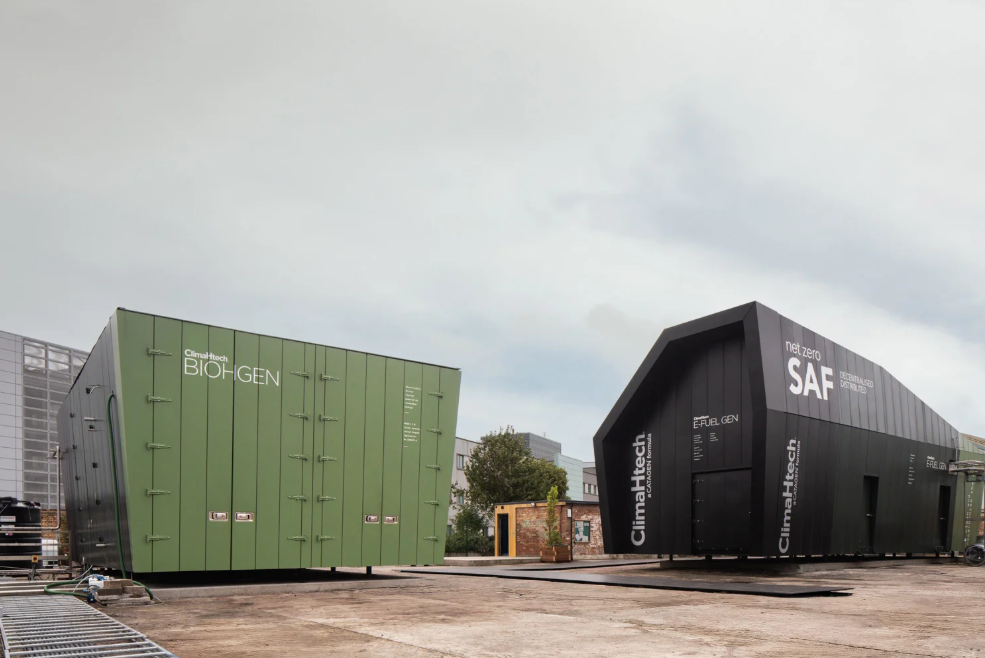
One of the company's areas of focus is sustainable aviation fuel, or SAF. Its subsidiary, ClimaHtech Green Flight, is developing modular systems capable of producing SAF using renewable electricity and sustainable biomass. Rather than depending solely on large, centralised production facilities, its approach is designed around smaller production units that can be deployed in different locations and scaled as demand increases.
There is already commercial interest. In May 2026, Loganair announced a 15-year SAF offtake agreement with ClimaHtech Green Flight. The two companies said at the time that they intended to work towards supplying SAF from 2029.
Getting from development to commercial reality
For CATAGEN, the new UKEF-backed funding is important because it addresses a problem that affects many growing technology businesses.
Developing something is one thing. Commercialising it is another. Research and development have to become manufacturing. Prototypes have to become products. And prospective customers eventually have to become paying ones. That transition costs money.
Dr Andrew Woods, CATAGEN's CEO and founder, said the UKEF backing had been "instrumental in bridging the gap" between late-stage product development and commercialisation. He added that it had allowed the business to accelerate its SAF technology towards the market and strengthen the foundations for further international growth.
For other UK SMEs considering international expansion, that is perhaps the most interesting part of the story. Exporting isn't simply something that happens after a product has been finished. For some companies, access to finance is part of what makes it possible to reach that point in the first place.
Government sees an export opportunity
The UK Government clearly hopes CATAGEN can turn its technology into an international success story.
Minister for Trade Anas Sarwar said:
"CATAGEN is exactly the kind of innovative business this Government wants to back to expand as we look to drive growth in every postcode."
He said businesses such as CATAGEN were important to the Government's Industrial Strategy, supporting highly skilled employment and its ambitions for clean energy and aviation. UKEF's Lauren Dougherty was more explicit about the international opportunity, saying the company's modular technology could be sold globally and that the backing should help CATAGEN move into commercial production and reach more overseas customers.
That sits within a much bigger government effort to support exporters. UKEF says that during its last financial year it provided more than £11 billion in loans, guarantees and insurance to help UK businesses export and grow. It estimates that activity supported up to 85,000 jobs and contributed up to £6.4 billion to the UK economy. It has also set a target of supporting at least £10 billion of clean-growth business between 2024 and 2029.
The international opportunity
CATAGEN believes sustainable aviation fuel could provide a substantial export market. Aviation faces an unusually difficult decarbonisation challenge. Aircraft cannot simply follow cars down an obvious route towards widespread battery-electric propulsion, particularly for longer journeys, which has put considerable attention on alternative fuels. CATAGEN's approach is based on decentralised production.
ClimaHtech Green Flight says its technology can produce both e-SAF and Bio-SAF, using renewable electricity and sustainable biomass. Its production systems are designed to be manufactured off-site and deployed closer to sources of renewable electricity or to airports where the fuel is required. That makes the technology itself potentially exportable. And that distinction matters.
International business does not necessarily mean making a finished product in Britain, loading it onto a ship and sending it abroad. A British company might export equipment, technology, intellectual property or expertise. It might enter a new country through a local partner. Or, increasingly, it might combine several of those models. For a technology company based in Belfast, the potential market does not have to stop at the Irish Sea.
And CATAGEN isn't growing alone
There is another interesting number buried in the announcement. Eighty-five. That is the number of UK-based suppliers the Government says are supported by CATAGEN's activities, alongside the group's own 50 employees. It is a useful reminder of something that can easily get lost when we talk about exports.
The company winning the international business is only part of the story. Behind an exporter can sit engineers, manufacturers, software businesses, professional advisers and specialist suppliers, some of which may never describe themselves as exporters at all. When the business at the front of that chain grows internationally, the opportunity can travel backwards through its domestic supply chain too.
A lesson beyond aviation
Most UK SMEs are not developing technology to produce sustainable aviation fuel. But that doesn't make CATAGEN's story irrelevant to them. Quite the opposite.
For UK SMEs, reducing the environmental impact of aviation is not only a challenge for airlines and fuel producers. Businesses can also look more closely at the emissions associated with their own travel. Global Travel Management's Climate Contribution Programme helps companies measure, understand and reduce the impact of their business travel, before making a climate contribution against remaining emissions. You can find out more on Global Travel Management's Sustainability page.
Strip away the complicated engineering and there is a recognisable business problem underneath. You develop something people want. You prove that there is a market for it. Then comes the difficult bit: financing the move from development to commercialisation and finding a way to take it beyond your home market. CATAGEN is now trying to make precisely that transition. If it succeeds, a technology developed by a relatively small team in Belfast could find customers far beyond Northern Ireland, while supporting a much wider network of businesses back in the UK.
That is what makes this more than a story about sustainable aviation fuel. It is a story about what happens when British innovation meets the rather more complicated business of actually selling it to the world.